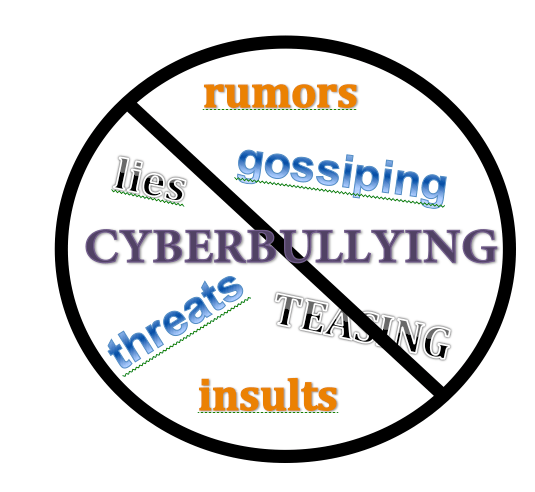
Cyberbullying or cyberharassment is a form of bullying or harassment using electronic means. Cyberbullying and Cyberharassment are also known as online bullying. It has become increasingly common, especially among teenagers.[1] Cyberbullying is when someone, typically teens, bully or harass others on social media sites. Harmful bullying behavior can include posting rumors, threats, sexual remarks, a victims’ personal information, or pejorative labels (i.e., hate speech).[2] Bullying or harassment can be identified by repeated behavior and an intent to harm.[3] Victims may have lower self-esteem, increased suicidal ideation, and a variety of emotional responses, including being scared, frustrated, angry, and depressed.
Awareness in the United States has risen in the 2010s, due in part to high-profile cases. Several US states and other countries have laws specific to cyberbullying. Some are designed to specifically target teen cyberbullying, while others use laws extending from the scope of physical harassment. In cases of adult cyberharassment, these reports are usually filed beginning with local police.
Research has demonstrated a number of serious consequences of cyberbullying victimization.
Internet trolling is a common form of bullying over the Internet in an online community (such as in online gaming or social media) in order to elicit a reaction, disruption, or for someone’s own personal amusement. Cyberstalking is another form of bullying or harassment that uses electronic communications to stalk a victim; this may pose a credible threat to the victim.
Not all negative interaction online or on social media can be attributed to cyberbullying. Research suggests that there are also interactions online that result in peer pressure, which can have a negative, positive, or neutral impact on those involved.
IN GAMING

Of those who reported having experienced online harassment in a Pew Research poll, 16% said the most recent incident had occurred in an online game. A study from National Sun Yat-sen University observed that children who enjoyed violent video games were significantly more likely to both experience and perpetrate cyberbullying.
Another study that discusses the direct correlation between exposure to violent video games and cyber bullying also took into account personal factors such as “duration of playing online games, alcohol consumption in the last 3 months, parents drunk in the last 3 months, anger, hostility, ADHD, and a sense of belonging” as potential contributing factors of cyberbullying.
Gaming was a more common venue for men in which to experience harassment, whereas women’s harassment tended to occur via social media. Most respondents considered gaming culture to be equally welcoming to both genders, though 44% thought it favored men. Keza MacDonald writes in The Guardian that sexism exists in gaming culture, but is not mainstream within it. Sexual harassment in gaming generally involves slurs directed towards women, sex role stereotyping, and overaggressive language.[40] U.S. President Barack Obama made reference to the harassment of women gamers during his remarks in honor of Women’s History Month.
Competitive gaming scenes have been less welcoming of women than has broader gaming culture. In an internet-streamed fighting game competition, one female gamer forfeited a match after the coach of her team, Aris Bakhtanians, stated, “The sexual harassment is part of the culture. If you remove that from the fighting game community, it’s not the fighting game community.” The comments were widely condemned by gamers, with comments in support of sexual harassment “drowned out by a vocal majority of people expressing outrage, disappointment and sympathy.” The incident built momentum for action to counter sexual harassment in gaming.
Some game developers have been subjected to harassment and death threats by players upset by changes to a game or by a developer’s online policies. Harassment also occurs in reaction to critics such as Jack Thompson or Anita Sarkeesian, whom some fans see as threats to the medium. Various people have been harassed in connection with the Gamergate controversy. Harassment related to gaming is not of a notably different severity or tenor compared to online harassment motivated by other subcultures or advocacy issues.
Sabotage among rival crowdfunding campaigns is a recurring problem for projects related to gaming.
Some instances of swatting in games such as Call of Duty and League of Legends have resulted in law enforcement SWAT units called on individuals’ homes as a prank. On December 28, 2017, Wichita, Kansas police officers killed Andrew Finch at his Kansas home in a reported swatting prank.
IN SEARCH ENGINES
Information cascades happen when users start passing along information they assume to be true, but cannot know to be true, based on information on what other users are doing. This can be accelerated by search engines’ ranking technologies and their tendency to return results relevant to a user’s previous interests. This type of information spreading is hard to stop. Information cascades over social media and the Internet may also be harmless, and may contain truthful information.
Bullies use Google bombs (a term applicable to any search engine)[citation needed] to increase the prominence of favored posts sorted by the most popular searches, done by linking to those posts from as many other web pages as possible. Examples include the campaign for the neologism “santorum” organized by the LGBT lobby. Google bombs can manipulate the Internet’s search engines regardless of how authentic the pages are, but there is a way to counteract this type of manipulation as well.
 .
.
Cyberstalking
Cyberstalking is a form of online harassment in which the perpetrator uses electronic communications to stalk a victim. This is considered more dangerous than other forms of cyberbullying because it generally involves a credible threat to the victim’s safety. Cyberstalkers may send repeated messages intended to threaten or harass. They may encourage others to do the same, either explicitly or by impersonating their victim and asking others to contact them.
Trolling
Internet trolls intentionally try to provoke or offend others in order to elicit a reaction.[11] Trolls and cyberbullies do not always have the same goals: while some trolls engage in cyberbullying, others may be engaged in comparatively harmless mischief. A troll may be disruptive either for their own amusement or because they are genuinely a combative person.
 BULLYING: CYBER BULLY